Abstract
Humidity is not a single failure mechanism. It is an environmental boundary condition that enables coupled physical and electrochemical processes: water adsorption, capillary condensation, contaminant deliquescence, ionic conduction, corrosion, electrochemical migration, conductive anodic filament growth, package delamination and moisture-assisted degradation of components and printed circuit boards.
The principal engineering conclusion is that relative humidity alone is an insufficient predictor of risk. Reliability depends on the local surface state: surface temperature, dew-point margin, contaminant chemistry, deposited chloride or sulfur compounds, electrical bias, conductor geometry, material system, enclosure behavior and exposure duration.
This report supports environmental screening and qualification planning. It does not predict product failure probability without product-specific design, materials, contamination and field-failure evidence.
Executive summary
Electronic devices can fail in humid environments even when no visible droplets are present. Water molecules adsorb onto surfaces, collect in microscopic gaps and dissolve ionic contaminants. The resulting electrolyte film can conduct current and support electrochemical reactions.
| Engineering point | Meaning for electronics |
|---|---|
| Invisible moisture matters | Adsorbed and deliquesced water films can conduct before visible condensation appears. |
| Contaminants change thresholds | Chlorides, sulfur compounds, particles and residues can make surfaces conductive at lower RH. |
| Voltage bias changes the problem | Moisture plus electric field can enable electrochemical migration and dendrite formation. |
| Condensation accelerates mechanisms | Cyclic wetting redistributes ions and increases corrosion and leakage relevance. |
| Accelerated tests are model-dependent | 85/85 or damp-heat tests require mechanism consistency before field extrapolation. |
Psychrometrics and condensation physics
Relative humidity is the ratio between actual water-vapor partial pressure and saturation vapor pressure at the same air temperature. It is strongly temperature-dependent. Cooling air without removing moisture increases RH because saturation vapor pressure decreases.
RH = p_v / p_sat(T)DeltaT_dp = T_surface - T_dewpointCondensation becomes possible when a surface is at or below the dew point of the surrounding air. For electronics, the decisive surface may be a connector pin, PCB trace, enclosure wall, shield can or cold internal component, not the measured ambient air temperature.
From humidity to electrolyte films
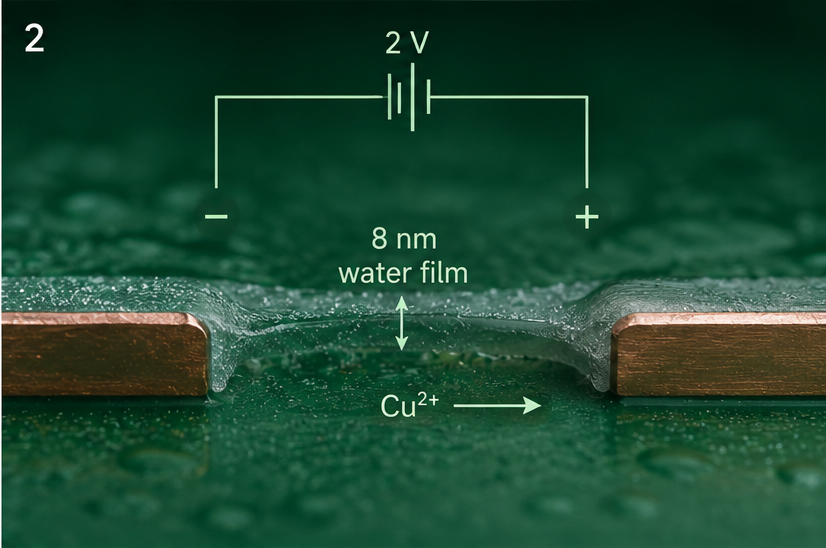
Moisture can exist as adsorbed molecular layers, capillary condensate in small gaps, or deliquesced liquid created by hygroscopic salts and residues. These films can be extremely thin but still electrically relevant.
Surface insulation resistance is therefore a system property of substrate, residues, geometry, voltage, temperature and humidity. A dry functional test can miss the failure mechanism because the electrolyte disappears during conditioning.
Atmospheric chemistry and deposited contaminants
Pure condensed water has limited conductivity until it absorbs ions and gases. Electronic assemblies are rarely chemically pristine. Manufacturing residues, marine chloride, road salt, sulfur compounds, nitrogen oxides, particles and dust can transform moisture into an electrolyte.
| Contaminant | Engineering relevance |
|---|---|
| Chloride | Increases electrolyte conductivity, destabilizes passive films and can promote localized corrosion. |
| Sulfur compounds | Can contribute to acidic surface chemistry and corrosion of contacts and metallization. |
| Particulates | Can hold moisture, carry salts and create local electrochemical microenvironments. |
| Flux residues | Can be hygroscopic and conductive, especially under humidity and voltage bias. |
Electrochemical corrosion of electronic materials
Corrosion requires an anodic reaction, a cathodic reaction, ionic conduction through an electrolyte and electronic continuity through the metal. In electronic assemblies, the vulnerable features are often small: exposed copper, solder joints, cut edges, porous plating, connector contacts, component terminations and wire bonds after package ingress.
Visible corrosion is often a late-stage symptom. Electrical degradation, leakage current or contact-resistance increase may occur before obvious visual evidence appears.
Electrochemical migration and dendritic growth
Electrochemical migration requires voltage bias, an electrolyte path, ionic contamination and a metal system capable of dissolving and depositing. Metal dissolves at the anode, migrates as ionic or complexed species and deposits near the cathode. Branching metallic dendrites can eventually bridge conductors.
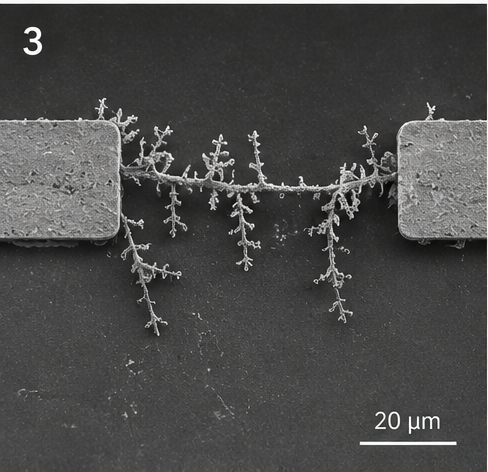
E = V / dFine conductor spacing increases electric field for a given voltage. The relevant geometry is local: pad spacing, creepage path, solder-mask defects, contamination bridges and coating discontinuities.
Conductive anodic filament growth
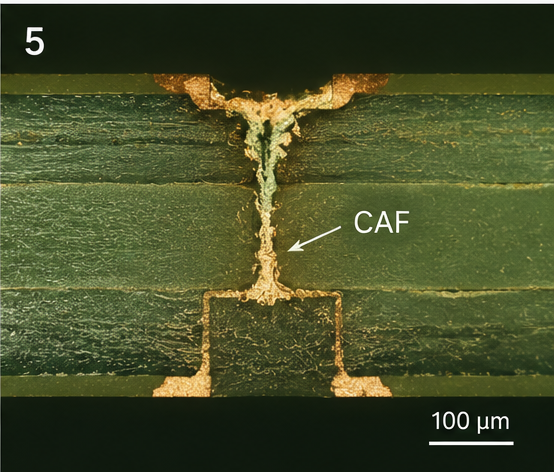
CAF differs from surface ECM. It occurs inside the PCB laminate, usually along glass-fiber and resin interfaces. Preconditions include moisture ingress, voltage bias, susceptible laminate pathways and ionic contamination. The resulting conductive filament can remain hidden until insulation resistance collapses.
Moisture in packages and components
Moisture diffuses through polymer packages, coatings and interfaces. During rapid heating, absorbed moisture can generate vapor pressure that contributes to delamination or cracking. This is the basis of moisture sensitivity handling for surface-mount devices.
tau ~ L^2 / DComponent-level behavior must be verified against manufacturer data. Broad statements about all capacitors, resistors or packages are not reliable enough for design decisions.
Quantitative reliability models
Humidity and temperature acceleration models can support test planning, but they are mechanism-specific. The exponent, activation energy and voltage terms are not universal constants.
AF_T = exp((E_a / k) * (1/T_use - 1/T_test))AF_RH = (RH_test / RH_use)^nAF = (RH_test / RH_use)^n * exp((E_a / k) * (1/T_use - 1/T_test))The dominant failure mechanism must remain the same between test and field. Otherwise, extrapolation can be misleading even if the test is severe.
Engineering screening framework
A practical screening framework combines the environmental boundary condition with product susceptibility. Location-based exposure is necessary, but not sufficient, for product risk evaluation.
| Input | Low concern | Higher concern |
|---|---|---|
| Environment | Low humidity, low deposition, stable temperatures | High RH, dew-point proximity, chloride or sulfur context |
| Electrical design | Low bias, wide spacing, protected surfaces | High field strength, fine spacing, exposed conductors |
| Materials | Qualified corrosion-resistant system | Exposed active metal, porous finish, sensitive laminate |
| Manufacturing | Low ionic contamination | Residues, particles, poor cleaning or handling contamination |
Qualification and design mitigation
Humidity qualification should match the field mechanism. Constant damp heat, cyclic damp heat, temperature-humidity-bias, HAST, CAF testing, mixed-flowing gas and SIR testing answer different engineering questions.
Use this as a screening checklist before selecting a humidity or corrosion qualification path.
Use this as a screening checklist before selecting a humidity or corrosion qualification path.
Use this as a screening checklist before selecting a humidity or corrosion qualification path.
Use this as a screening checklist before selecting a humidity or corrosion qualification path.
Use this as a screening checklist before selecting a humidity or corrosion qualification path.
Use this as a screening checklist before selecting a humidity or corrosion qualification path.
Use this as a screening checklist before selecting a humidity or corrosion qualification path.
Climetry-oriented exposure architecture
Climetry connects climate and atmospheric datasets with engineering post-processing. ERA5 provides thermodynamic exposure such as temperature, dew point, RH and pressure. Atmospheric modeling adds context for chloride, SOx and regional pollutant screening. CEY converts multi-year climate behavior into representative hourly exposure for engineering statistics.
ISO atmospheric-corrosion standards provide environmental context, but they should not be treated as direct PCB lifetime models. Electronic assemblies involve smaller geometries, voltage bias, residues, coatings and different materials.
Standards and authoritative references
| Reference | Use in interpretation |
|---|---|
| ISO 9223 | Atmospheric corrosivity classification using temperature-humidity complex, sulfur dioxide pollution and airborne salinity. |
| ISO 9224 | Guiding corrosion values for atmospheric corrosivity categories. |
| ISO 9226 | Determination using standard specimens for atmospheric corrosivity evaluation. |
| IEC 60068 | Environmental testing family including damp heat, cyclic damp heat and related qualification methods. |
| IPC TM-650 | Test methods used in electronic assembly reliability, insulation resistance and CAF-related assessment. |
| J-STD-020 / J-STD-033 | Moisture sensitivity and handling guidance for surface-mount devices. |
If you need a readable overview instead of the full technical reference, start with the cornerstone article.