Introduction
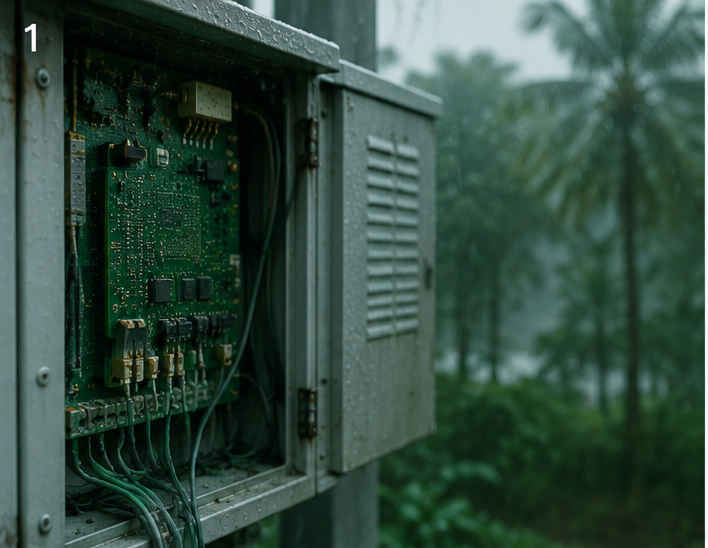
Humidity is one of the most underestimated environmental stress factors affecting electronic systems. Engineers often focus on temperature, vibration, and mechanical shock, but moisture is responsible for a large share of long-term field failures.
Unlike a liquid water spill, humidity acts silently. Water molecules adsorb onto surfaces, form ultra-thin electrolyte films, dissolve contaminants, and enable electrochemical reactions that can ultimately result in corrosion, leakage currents, dendritic growth, conductive anodic filaments, and electrical short circuits.
Humidity alone is not the complete risk. Electronic failure depends on surface temperature, dew point, contamination, atmospheric chloride or sulfur deposition, electrical bias, conductor spacing, material selection and exposure duration.
Why humidity matters
Electronic assemblies are never perfectly clean. Even after manufacturing, surfaces may contain ionic residues from fluxes, airborne salts, sulfur compounds, dust particles, and organic contaminants.
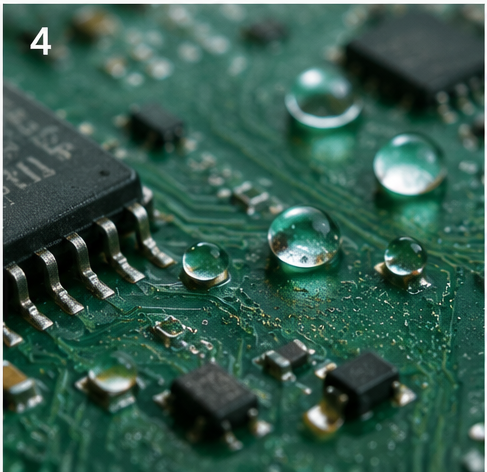
When humidity increases, these contaminants absorb moisture and create conductive pathways on the surface of printed circuit boards. The result can be a dramatic reduction in insulation resistance and the start of electrochemical degradation.
Electrochemical migration
Metal ions dissolve, migrate through a thin electrolyte film, and deposit as conductive material between biased conductors.
Dendrite growth
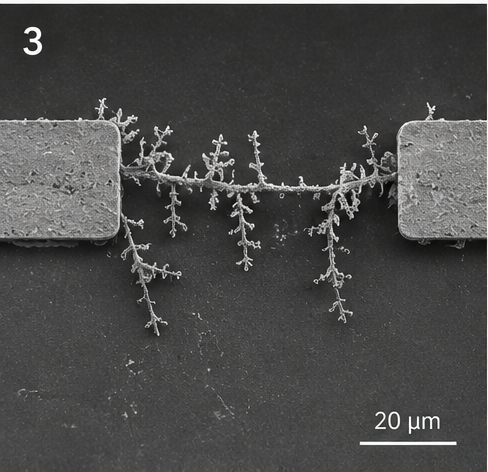
Metallic deposits can form branching structures that bridge pads or traces and create leakage paths or short circuits.
Condensation cycling
Repeated condensation and evaporation redistributes ionic contamination and accelerates corrosion processes.
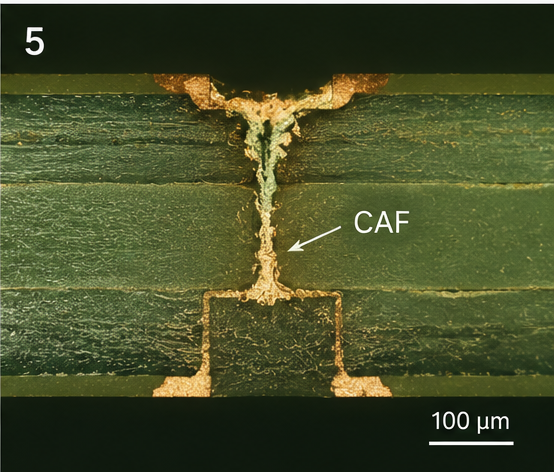
Conductive anodic filament
CAF grows inside PCB laminate along glass-fiber/epoxy interfaces under moisture, bias, and contamination.
The actual damage pathway
Pure water is rarely the complete problem. The damaging pathway begins when humidity or condensation creates a surface water film that dissolves salts, residues or atmospheric deposits. The resulting electrolyte can support corrosion, leakage current and ion migration.
Electrochemical migration: the core failure mechanism
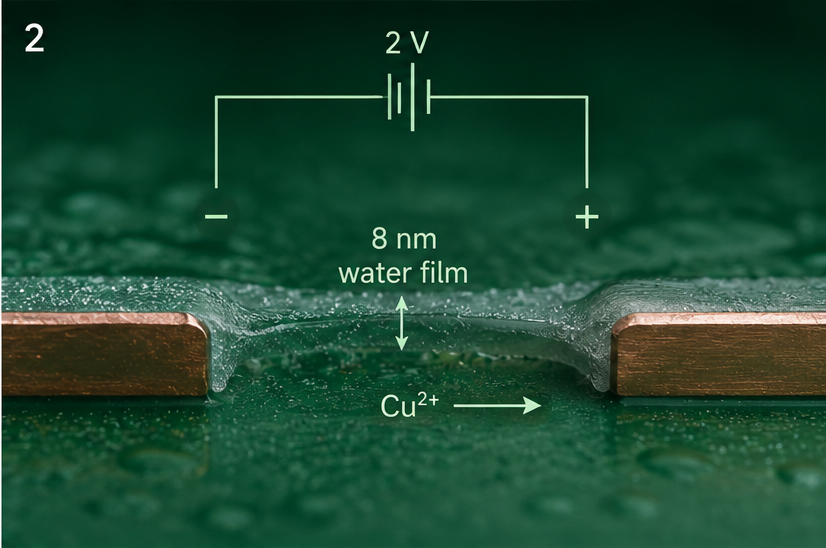
One of the most dangerous humidity-driven failure mechanisms is electrochemical migration. ECM occurs when metal ions dissolve from one conductor and migrate through a moisture layer toward another conductor, where they are deposited. Over time, the deposited metal can create conductive bridges known as dendrites.
Three conditions required for ECM
A voltage bias provides the driving force for ion transport. ECM risk becomes more relevant around 2 V and above.
Visible liquid water is not required. Nanometer-scale moisture films can already support electrochemical transport.
Materials such as silver, copper, and tin can dissolve at the anode, migrate as ions, and deposit at the cathode.
The electrochemical process
At the anode, metal atoms dissolve into ions. In simplified form, the reaction is M → Mn+ + ne-. The ions then migrate through the electrolyte film under the influence of the electric field.
At the cathode, ions are reduced and deposited as metallic material. With enough time, these deposits form branching structures that can bridge conductors and create short circuits.
Dendrites: the silent killer
Dendrites are particularly dangerous because they can form without obvious visual warning signs. A PCB may pass functional tests for months or years before failure occurs.
Once a dendrite bridges adjacent conductors, leakage current increases, insulation resistance collapses, intermittent failures appear, and permanent short circuits may occur.
Condensation: the accelerator
Humidity alone can be problematic. Condensation is often much worse. Condensation occurs whenever the surface temperature is below the dew point temperature.
Outdoor telecom cabinets, battery storage systems, automotive electronics, marine equipment, and industrial control cabinets can experience repeated condensation and evaporation cycles. This cycling redistributes contaminants and accelerates corrosion processes.
Conductive anodic filament growth
While ECM occurs on surfaces, conductive anodic filament growth occurs inside the PCB structure. CAF is a failure mechanism in multilayer boards where conductive filaments grow through the glass-fiber and epoxy interface.
CAF typically requires moisture, voltage bias, and ionic contamination. The resulting conductive path develops inside the laminate and may remain invisible from the outside.
Relative humidity thresholds
Humidity-related degradation does not suddenly begin at a single universal value. Risk depends on temperature, pollution level, material system, surface cleanliness, voltage bias, and enclosure design.
Still, practical experience shows that tropical locations such as Singapore, Jakarta, Bangkok, and Mumbai often experience thousands of annual hours above RH 80% and significant periods above RH 90%. These conditions create an environment where corrosion and ECM mechanisms can remain active for extended periods.
For electronics deployed in tropical, coastal, or polluted environments, humidity exposure hours and condensation risk are often more actionable than mean annual temperature.
Real deployment examples
The same PCB design can face very different field risks depending on where it is installed. Climate exposure turns the failure mechanism into a location-specific engineering question.
Singapore
Tropical humidity exposure- RH > 80%: about 4,500 h/year
- RH > 90%: recurring high-humidity periods
- Primary concern: corrosion and leakage current
Houston
Humid subtropical deployment- High warm-season humidity
- Frequent condensation-prone conditions
- Primary concern: enclosure moisture management
Mumbai
Coastal monsoon atmosphere- Marine aerosol seasonality
- High corrosion exposure
- Primary concern: connectors, coatings, and PCB protection
Why climate data matters
Electrochemical migration and corrosion are not only laboratory phenomena. Their relevance depends strongly on local climate conditions, including humidity, temperature, condensation potential, marine aerosol, airborne contamination, and the number of annual hours spent near critical exposure thresholds.
Climetry transforms global climate data into engineering-relevant exposure metrics that help identify high-risk deployment environments before products are shipped. Instead of asking only whether a product passed a generic damp-heat test, engineers can ask whether the test severity matches Singapore, Houston, Mumbai, Dubai, Frankfurt, or a complete regional deployment envelope.
Humidity explains the failure mechanism. Climate exposure metrics explain where that mechanism is likely to matter most in the field.
Best practices for engineers
Minimize ionic residues, improve cleaning, verify board cleanliness, and control handling contamination.
Manage thermal gradients, monitor dew point conditions, and avoid enclosure concepts that trap moisture.
Improve sealing, use desiccants where appropriate, and select enclosure concepts that support drying.
Use corrosion-resistant finishes, suitable conformal coatings, and moisture-resistant laminate systems.
Consider THB, HAST, CAF testing, and surface insulation resistance testing for critical applications.
Common misconceptions
False. Hygroscopic residues, local cold spots, fine conductor spacing and voltage bias can create risk at lower RH.
False. Microscopic adsorbed or deliquesced films can conduct ions and support electrochemical activity.
Not necessarily. Moisture can be trapped, permeate materials or enter through imperfect seals.
False. Coating over residues can trap contamination and cause underfilm corrosion.
False. Acceleration depends on mechanism, materials, voltage and model parameters.
Conclusion
Humidity damages electronics not because water is present in large quantities, but because extremely thin moisture films can enable electrochemical reactions.
When voltage bias, electrolyte films, contamination, and susceptible metals are combined, corrosion, dendrite formation, and CAF growth become possible. Understanding and quantifying humidity exposure is therefore essential for modern reliability engineering, particularly in tropical, coastal, and polluted environments.
References
This article summarizes well-established humidity, corrosion, ECM, and CAF mechanisms used in electronics reliability engineering. The references below are starting points for standards alignment and technical traceability.
Test methods for electronic assemblies, including humidity, insulation resistance, and CAF-related reliability assessment.
Environmental testing standard family covering damp heat, temperature cycling, mixed gas corrosion, salt mist, and related qualification methods.
Established reliability literature describing water adsorption, metal dissolution, ion migration, dendrite growth, and insulation resistance collapse.
CAF research and IPC test methods connecting moisture, voltage bias, laminate structure, contamination, and internal PCB shorts.
Global climate reanalysis used to derive humidity exposure, temperature, dew point, condensation potential, and location-specific climate metrics.
Read the technical report for psychrometrics, dew-point margin, surface films, chloride and sulfur chemistry, corrosion kinetics, electrochemical migration, CAF, acceleration models, standards and qualification guidance.
Humidity and electronics FAQ
Can high humidity damage electronics?
Yes. High humidity can form adsorbed or deliquesced moisture films on PCB surfaces. If residues, salts or pollutants are present, those films can become conductive and support corrosion, leakage current or electrochemical migration.
At what humidity do electronics become unsafe?
There is no universal safe humidity limit. Risk depends on surface temperature, dew point, contamination, voltage bias, conductor spacing, material system and exposure duration.
Can electronics fail without visible condensation?
Yes. Visible droplets are not required. Nanometer-scale adsorbed water films and deliquesced contaminants can already reduce insulation resistance or enable electrochemical processes.
What is electrochemical migration?
Electrochemical migration is a biased moisture-driven process where metal dissolves at an anode, migrates as ions through an electrolyte film and deposits near a cathode, sometimes forming dendrites.
What is CAF in a PCB?
Conductive anodic filament growth is an internal PCB laminate failure mechanism where conductive paths grow along glass-fiber and resin interfaces under moisture, contamination and voltage bias.
Does conformal coating prevent humidity damage?
It can help, but it is not a universal fix. Coating over residues, poor adhesion, voids, edge defects or trapped moisture can still allow underfilm corrosion or leakage.
Can a sealed enclosure still develop condensation?
Yes. Moisture may be trapped during assembly, permeate through materials, enter through imperfect seals or condense on cold internal surfaces during thermal cycling.
Does 85/85 testing predict field lifetime?
Not by itself. Accelerated humidity testing is useful only when the field failure mechanism, materials, voltage bias and acceleration model remain valid.
How does chloride exposure affect electronics?
Chloride deposition increases electrolyte conductivity, promotes corrosion of many metals and can lower the humidity threshold at which residues become problematic.
Quantify humidity exposure before electronics fail.
Analyze RH80/RH90 hours, condensation potential, corrosion screening, CAMS modifiers, and climate exposure reports for deployment locations.