Introduction
Engineers routinely design products for mechanical loads, electrical loads, and thermal loads. A gearbox is designed for torque. A battery is designed for charge-discharge cycles. An enclosure is designed for ingress protection.
Yet one of the most influential environmental loads often remains poorly quantified: climate exposure.
Climate exposure determines how often materials become wet, how frequently condensation forms, how aggressively corrosion develops, and how rapidly outdoor assets age. For many products, climate is not merely a background condition. It is an active engineering load that continuously acts on materials throughout their service life.
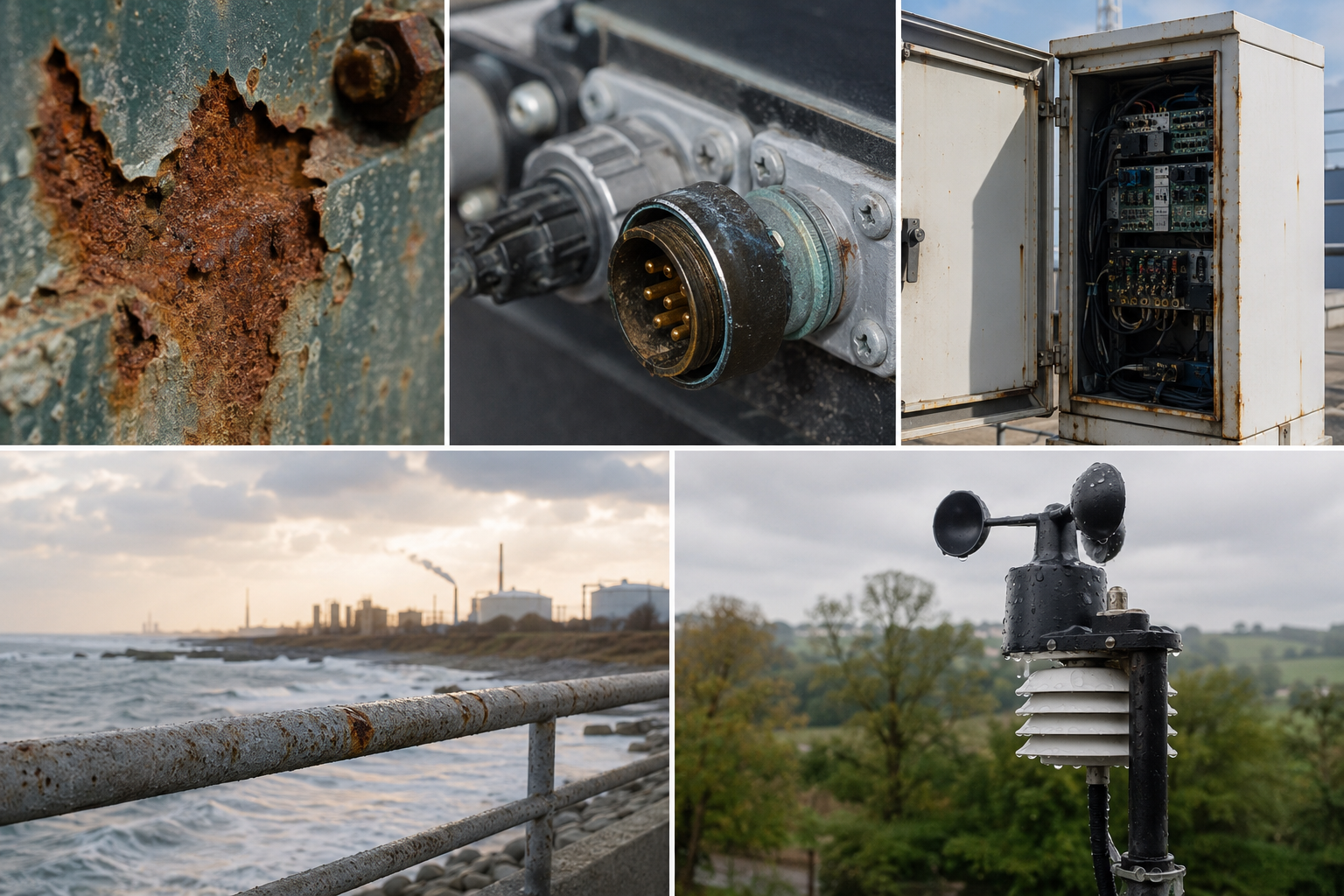
Climate exposure is not weather decoration. It is a durability load acting on materials, electronics, seals, coatings, connectors, batteries, and outdoor infrastructure.
Climate is more than temperature
When people think about climate, they often think first about temperature. For engineering systems, temperature is only one component of environmental exposure.
Relative humidity
Relative humidity determines how close the atmosphere is to saturation. At elevated humidity levels, thin electrolyte films can form on metallic surfaces, enabling electrochemical corrosion processes.
Absolute humidity
Absolute humidity describes the actual mass of water vapor present in air. For electronics and enclosed systems, it is often a better indicator of moisture stress.
Dew point and condensation
Condensation occurs when a surface cools below the dew point temperature. Thousands of condensation cycles over years can become a major reliability concern.
Atmospheric corrosion
Atmospheric corrosion severity is influenced by humidity, temperature, chlorides, sulfur compounds, nitrogen compounds, dust accumulation, and wetness duration.
Why location matters
All outdoor products experience climate, but the engineering implications are dramatically different by location. Singapore, Dubai, and Frankfurt all represent outdoor deployment environments, but they do not represent the same durability load.
Electronics corrosion, connector degradation, mold growth, condensation risk.
Hot arid coastalDubaiThermal stress, coastal salt influence, UV degradation, and daily temperature cycles.
TemperateFrankfurtSeasonal moisture exposure, temperature cycling, and winter environmental stress.
From weather data to engineering intelligence
Traditional weather services provide temperature, humidity, wind, and rainfall. These variables are valuable, but they do not directly answer engineering questions.
Engineers need to know how many hours exceed critical humidity thresholds, how often condensation can occur, what corrosion environment is expected, and how severe a location is compared with other deployment sites.
These questions require transforming climate data into engineering metrics.
Climate exposure metrics
Annual hours with relative humidity at or above 80%, often used as a practical wet-hour proxy for corrosion susceptibility.
Annual hours with relative humidity at or above 90%, often associated with severe moisture stress and condensation-prone conditions.
Hours when air temperature and dew point are sufficiently close to indicate elevated condensation risk.
A climate-derived indicator combining humidity, temperature, moisture persistence, marine exposure, and environmental aggressiveness.
Daily temperature range and cycle counters that help identify thermal fatigue and enclosure breathing stress.
P50, P90, P95, and maximum conditions across countries, states, or custom deployment regions.
The rise of climate exposure intelligence
Historically, engineers relied on local experience, corrosion maps, generic environmental classes, and limited field data. Today, global climate datasets enable a different approach: every location can be analyzed with consistent methodology.
This enables site screening, product qualification, asset deployment planning, regional environmental assessments, and climate-informed design decisions.
Beyond individual locations
Modern organizations rarely deploy products at one site. Vehicles, telecom infrastructure, renewable energy assets, and industrial equipment are usually deployed across entire regions.
Understanding the environmental envelope of a region becomes as important as understanding any single location. The question changes from "what is the climate at this point?" to "what climate envelope must this product survive across India, Germany, Southeast Asia, or a specific operating region?"
What are the 95th percentile humidity conditions across India? Which areas of Germany present the highest corrosion exposure? How severe is environmental stress across Southeast Asia?
The future of environmental qualification
Environmental qualification standards have traditionally focused on laboratory testing. Increasingly, organizations seek to connect laboratory testing with actual deployment environments.
Climate exposure intelligence helps bridge that gap by quantifying humidity stress, corrosion potential, condensation exposure, temperature extremes, and regional environmental envelopes using real-world climate information.
Conclusion
Climate is not merely a weather statistic. It is a continuous engineering load acting on every outdoor asset, electronic system, battery installation, vehicle, and infrastructure component.
The challenge is no longer obtaining climate data. The challenge is converting climate data into engineering intelligence.
That is the purpose of climate exposure analysis. And it is the mission behind Climetry.
Analyze environmental exposure before products fail.
Explore location-level climate exposure, corrosion screening, condensation risk, humidity hours, and engineering PDF reports.