Introduction
As the automotive industry transitions from internal combustion engines to electric vehicles, attention is often focused on battery technology, charging infrastructure and driving range. Yet one of the most significant long-term reliability challenges remains surprisingly traditional: corrosion.
Some environmental exposure mechanisms may become even more critical in electric vehicles than in conventional combustion-powered platforms.
EV architectures introduce new vulnerabilities related to humidity, moisture retention, electrical connectivity, battery systems and high-voltage electronics. Understanding these risks is becoming increasingly important for OEMs, Tier-1 suppliers, fleet operators and charging infrastructure providers.
Corrosion did not disappear with electrification
A common misconception is that electric vehicles contain fewer moving parts and therefore face fewer durability challenges. EVs eliminate many engine-related mechanical systems, but they introduce a significant increase in corrosion-sensitive electrical and thermal systems.
Potentially sensitive to moisture, contamination, corrosion or electrical contact degradation.
Potentially sensitive to moisture, contamination, corrosion or electrical contact degradation.
Potentially sensitive to moisture, contamination, corrosion or electrical contact degradation.
Potentially sensitive to moisture, contamination, corrosion or electrical contact degradation.
Potentially sensitive to moisture, contamination, corrosion or electrical contact degradation.
Potentially sensitive to moisture, contamination, corrosion or electrical contact degradation.
Potentially sensitive to moisture, contamination, corrosion or electrical contact degradation.
The result is a shift from traditional mechanical degradation toward electrochemical and electrical reliability challenges.
The EV moisture retention problem
One less obvious consequence of electrification is the reduction of waste heat. In conventional combustion vehicles, engine compartments routinely experience high operating temperatures that promote drying of accumulated moisture after wet exposure.
Electric vehicles operate differently. Although batteries and power electronics generate heat, thermal management systems actively regulate temperatures and often maintain significantly lower operating conditions than traditional engines.
Moisture can remain longer on surfaces, drying cycles can become less effective, water films can persist for longer periods and corrosion initiation can become more likely.
From a corrosion perspective, lower temperatures are not always beneficial. For many atmospheric corrosion mechanisms, prolonged wetness duration can be more important than peak temperature.
Battery enclosures: a new corrosion hotspot
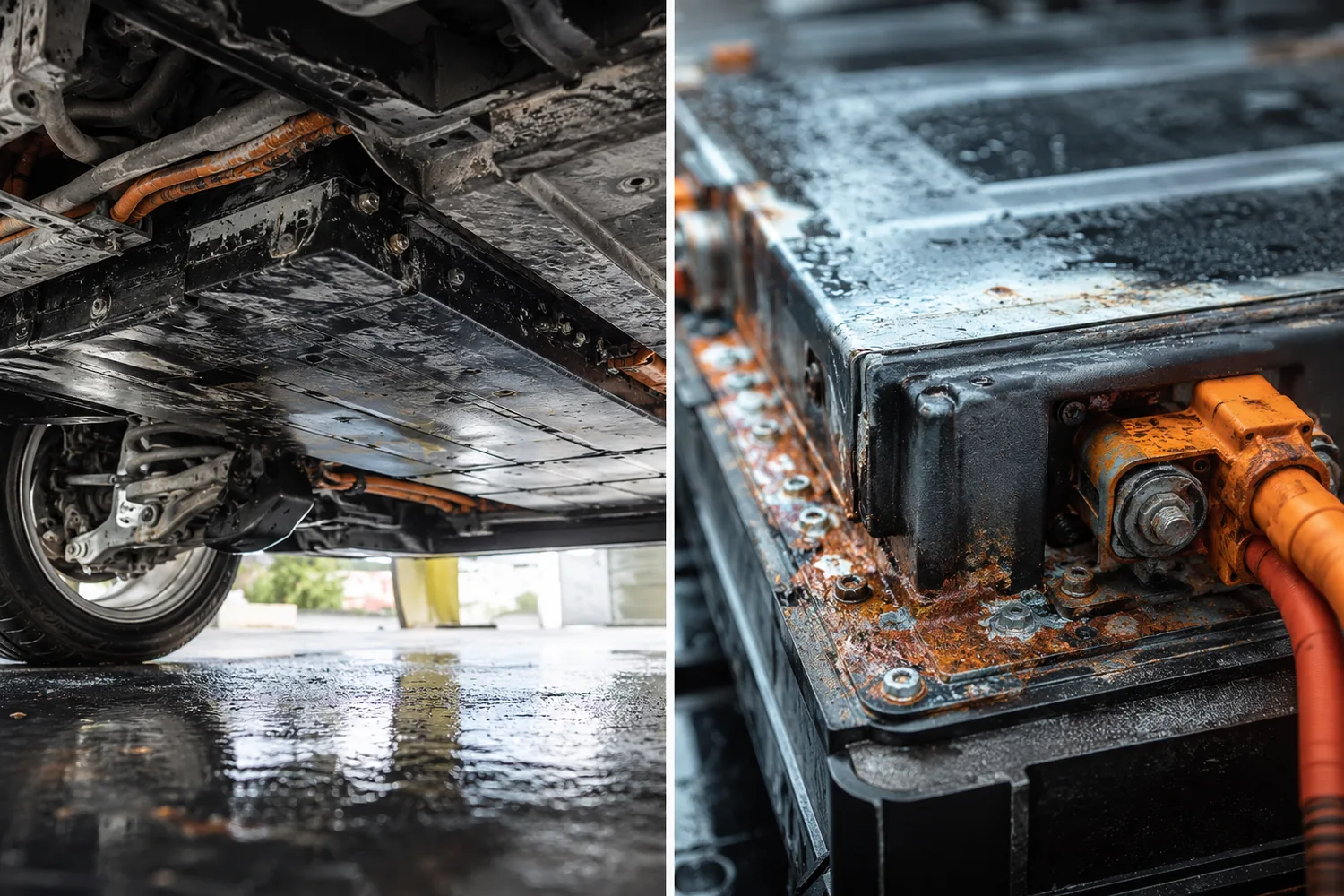
The battery pack is the most valuable component of an electric vehicle. Modern battery enclosures typically contain aluminum structures, steel fasteners, cooling systems, electrical interconnects and sealing systems.
These components can be exposed to humidity, road spray, chloride contamination, temperature cycling and mechanical vibration. The combination creates ideal conditions for several degradation mechanisms.
Galvanic corrosion
Dissimilar metals such as aluminum and stainless steel can form galvanic cells in the presence of moisture and ionic contamination.
Crevice corrosion
Sealed joints and interfaces may trap moisture and create oxygen-depleted environments that promote localized attack.
Pitting corrosion
Chloride-rich environments can attack protective oxide layers on aluminum surfaces and initiate pitting.
These degradation mechanisms can compromise structural integrity, sealing performance and long-term reliability.
High-voltage connectors and electrical reliability
Modern EVs contain hundreds of electrical connections, including battery terminals, high-voltage connectors, sensor interfaces, power distribution systems and charging connections.
Corrosion at these interfaces can cause measurable impacts on system efficiency and reliability.
Connector and interface degradation can become a system-level reliability concern over vehicle lifetime.
Connector and interface degradation can become a system-level reliability concern over vehicle lifetime.
Connector and interface degradation can become a system-level reliability concern over vehicle lifetime.
Connector and interface degradation can become a system-level reliability concern over vehicle lifetime.
Connector and interface degradation can become a system-level reliability concern over vehicle lifetime.
For high-voltage systems, maintaining stable low-resistance connections throughout the vehicle lifetime is essential.
Electrochemical migration: the invisible threat
Many reliability engineers focus on visible corrosion. However, one of the most dangerous failure mechanisms can develop before visible corrosion products appear.
Electrochemical migration requires an electrical potential difference, a thin conductive moisture film and soluble metal species. Visible condensation is not always required. In humid environments, conductive water films only a few nanometers thick may be sufficient to support electrochemical processes under certain conditions.
In EV power electronics and battery management systems, ECM can lead to leakage currents, dendritic growth, short circuits and progressive reliability degradation.
Charging infrastructure faces similar challenges
Corrosion risk extends beyond the vehicle. Public charging stations are continuously exposed to rain, condensation, salt spray, UV radiation and industrial pollution.
Affected components include connectors, contact pins, cable terminations, enclosures and grounding systems. Degradation of charging interfaces can reduce charging reliability and increase maintenance cost.
Cooling systems and corrosion
Most modern EVs rely on liquid thermal management systems. Heat exchangers, coolant loops, pumps, radiators and pipework can all become corrosion-relevant components.
Corrosion-related failures may result in coolant leaks, reduced heat-transfer efficiency, blockages and thermal management degradation. Since battery longevity is strongly linked to thermal control, cooling system reliability directly influences vehicle performance and battery lifetime.
Why climate matters more than many engineers realize
Corrosion is not determined by material selection alone. Environmental exposure often becomes the dominant factor.
Consider two identical electric vehicles: one operating in Munich, with moderate humidity and limited chloride exposure, and one operating in Singapore, with persistent high humidity, frequent condensation conditions and elevated atmospheric chloride relevance.
Corrosion risk is location-dependent. Understanding environmental exposure before deployment is increasingly important for vehicle design, qualification and fleet management.
The fleet operator perspective
For fleet operators, corrosion is not merely a technical issue. It affects vehicle availability, maintenance costs, warranty claims, residual value and lifecycle economics.
A fleet operating in tropical coastal environments may experience substantially different degradation rates than a comparable fleet deployed in continental climates. Environmental exposure assessment can therefore become an input for maintenance planning, warranty strategy, asset valuation and replacement forecasting.
The role of environmental qualification
Automotive qualification standards are becoming increasingly rigorous, but qualification programs often face a fundamental question: which environmental conditions should be tested?
Testing against unrealistic conditions increases cost. Testing against insufficient conditions increases risk. Climate-informed qualification offers a more targeted approach by aligning humidity exposure, condensation potential, marine influence and pollution burden with actual deployment conditions.
How Climetry helps
Traditional climate datasets provide temperature, humidity and weather information. Climetry transforms climate data into engineering exposure intelligence.
Climetry Exposure Classes describe overall environmental severity and are not equivalent to ISO corrosivity classes. Steel and aluminum corrosivity remain ISO-derived material indicators, while CE classes express broader qualification relevance.
Converted into practical indicators for corrosion, condensation, durability screening and qualification planning.
Converted into practical indicators for corrosion, condensation, durability screening and qualification planning.
Converted into practical indicators for corrosion, condensation, durability screening and qualification planning.
Converted into practical indicators for corrosion, condensation, durability screening and qualification planning.
Converted into practical indicators for corrosion, condensation, durability screening and qualification planning.
Converted into practical indicators for corrosion, condensation, durability screening and qualification planning.
These metrics allow engineering teams to compare deployment environments using a common framework rather than hundreds of individual climate variables.
Temperate Central European benchmark with seasonal moisture and winter stress.
CE-3 / CE-4HoustonHumid subtropical exposure relevant for condensation and corrosion screening.
CE-4 / CE-5SingaporePersistent humid tropical exposure with strong electronics and enclosure relevance.
CE-5MumbaiTropical marine exposure with high humidity and coastal corrosion relevance.
Corrosion is becoming a strategic EV reliability challenge
The transition to electrification does not eliminate corrosion. In many respects, it increases its importance.
Battery systems, high-voltage electronics, charging infrastructure and advanced thermal management systems introduce new pathways through which environmental exposure can affect reliability.
As electric vehicles are deployed into increasingly diverse climates, the question is no longer simply how corrosive a material is. The more important question is: how aggressive is the environment in which this vehicle must survive?
Screen climate exposure before deployment.
Analyze humidity, condensation, corrosion, marine influence and CE class for product and infrastructure locations.