Introduction
Photovoltaic technology has become one of the most important pillars of the global energy transition. Modern solar modules are designed for service lifetimes exceeding 25 years and are increasingly deployed in deserts, tropical coastlines, alpine environments, and industrial regions.
Yet field experience consistently shows that identical PV technologies can exhibit dramatically different degradation rates depending on deployment location. A solar installation in Central Europe may operate for decades with limited corrosion-related issues, while a similar installation in tropical Southeast Asia or along a marine coastline may experience accelerated degradation, connector failures, frame corrosion, seal deterioration, and higher maintenance requirements.
Solar modules do not age because of sunlight alone. They age because of climate exposure: humidity, chloride, pollution, UV, heat, soiling, and temperature cycling acting together over time.
Not all sunshine is equal
When evaluating a solar project, annual solar irradiation is often the first metric considered. Higher irradiation generally means higher energy yield. But energy production and durability are not the same question.
Two locations may produce similar annual electricity output while exposing equipment to very different environmental loads. From a reliability perspective, humidity exposure, condensation potential, marine influence, pollution burden, and temperature cycling can become just as important as energy yield.
Humidity is the hidden corrosion driver
Corrosion requires moisture, oxygen, and a susceptible material. Among these factors, humidity is often the most influential because tropical regions can remain above RH 80% for thousands of hours per year, with prolonged periods above RH 90% during nights and monsoon seasons.
Under these conditions, metallic surfaces can remain covered by thin electrolyte films that support electrochemical corrosion reactions. These microscopic moisture layers are often invisible but highly active.
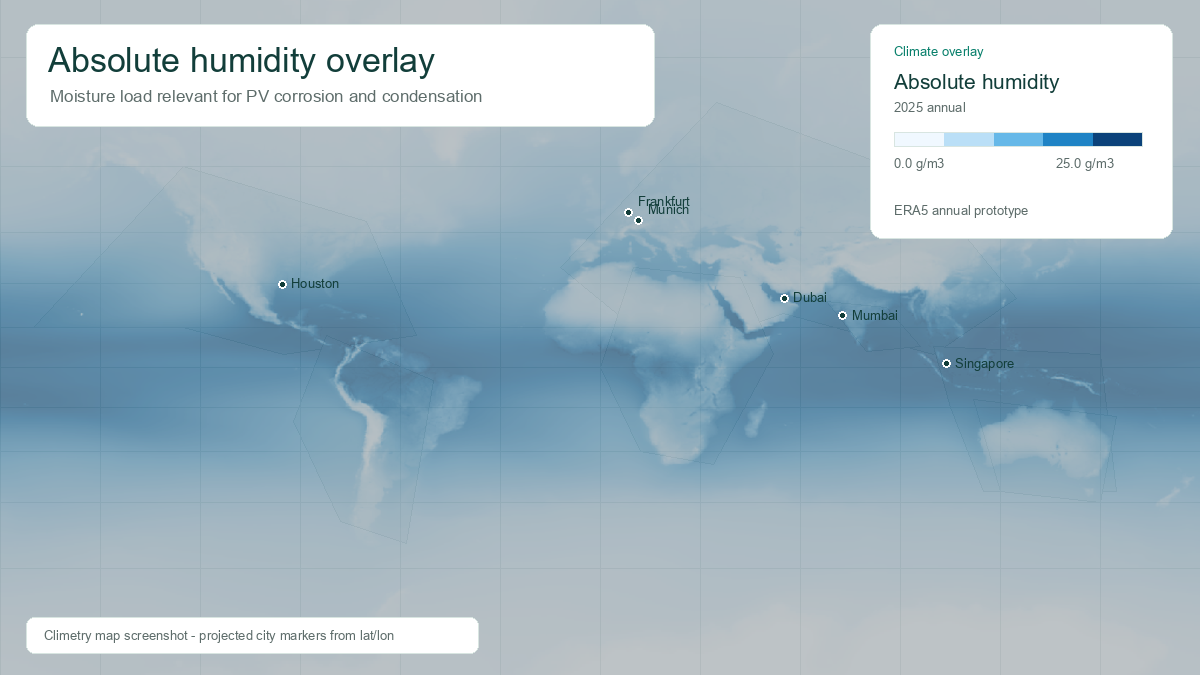
Humidity
Thousands of annual hours above RH 80% can maintain thin electrolyte films on fasteners, frames, connectors, junction boxes, and grounding systems.
Marine aerosol
Sea-salt particles deposit chloride-rich salts on exposed surfaces, absorb moisture, remain conductive, and promote localized corrosion.
Pollution
SO2, NOx, PM2.5, PM10, sulphate, and industrial particulates can dissolve into moisture films and form chemically aggressive electrolytes.
Temperature cycling
Daily module temperature swings create expansion and contraction loads that affect solder joints, interconnects, seals, and laminates.
UV and soiling
UV ages polymers and coatings, while dust, sand, pollen, industrial particles, and biological deposits can reduce yield and affect maintenance needs.
Why coastal environments are particularly aggressive
Humidity alone does not explain the full picture. One of the most important corrosion accelerators is airborne sea salt. Coastal regions continuously receive marine aerosols generated by breaking waves and sea spray.
These aerosols contain chloride-rich salts that deposit on exposed surfaces, absorb moisture from the atmosphere, remain conductive, and promote localized corrosion. Even short distances from the coastline can matter for long-term infrastructure investments.
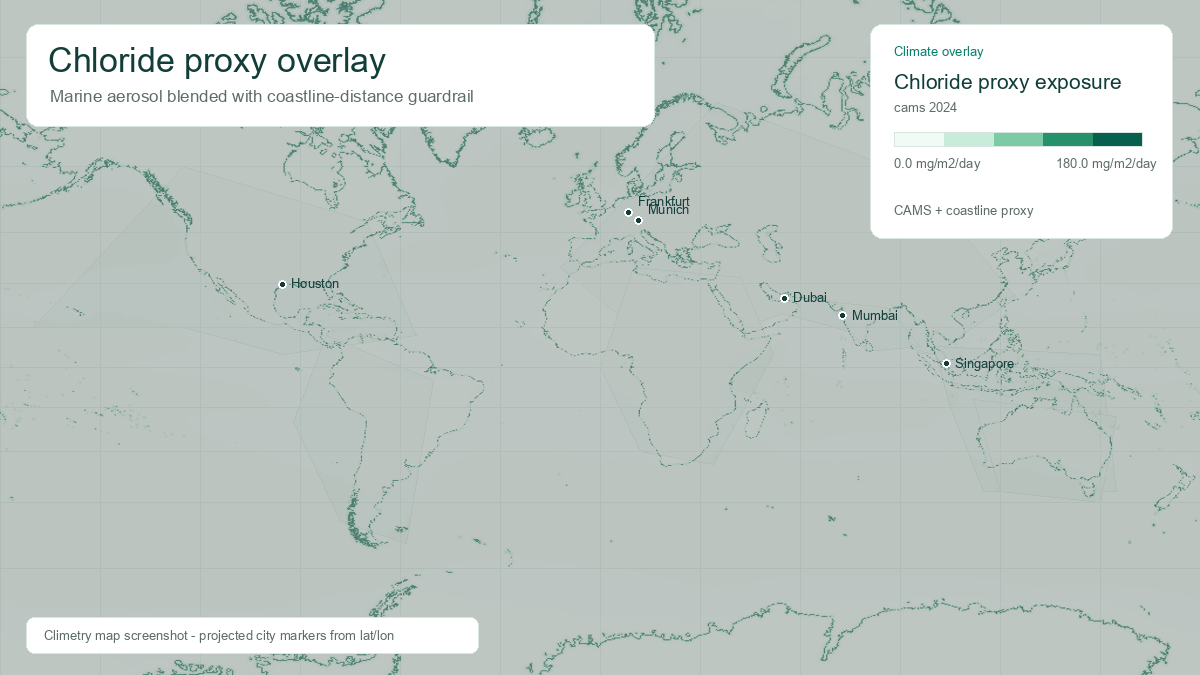
Atmospheric pollution can intensify corrosion
The atmosphere contains more than moisture and salt. Industrial emissions, transportation-related pollutants, and airborne particulates also influence corrosion. Particularly important are SO2, NOx, PM2.5, PM10, and sulphate aerosols.
When these pollutants dissolve in atmospheric moisture, they form chemically aggressive electrolytes. The combination of humidity, marine salt, and pollution often produces corrosion rates far higher than those expected from humidity alone.
Temperature cycling creates additional stress
Corrosion is only one of several important PV degradation mechanisms. Solar modules also experience continuous thermal expansion and contraction. Module temperatures can differ substantially from ambient air temperatures and may fluctuate by 40-60 C or more between day and night.
Over thousands of cycles, these thermal loads contribute to solder fatigue, interconnect degradation, delamination, seal degradation, and microcrack formation. Arid regions can be severe for thermomechanical stress even when corrosion risk is relatively low.
Comparing environmental exposure
Traditional climate labels are useful, but they rarely quantify the exposure loads that drive degradation. A more useful view compares location-specific stressors directly.
Moderate humidity, limited marine influence, moderate pollution, and seasonal temperature cycling.
High exposureSingaporePersistent humidity, frequent condensation potential, marine aerosol context, and high temperatures year-round.
Very high exposureCoastal IndiaMonsoon humidity, marine salt deposition, seasonal pollution, and corrosion-sensitive deployment conditions.
Thermal and UV dominatedPhoenixVery low humidity and limited corrosion risk, but strong UV exposure and high thermal cycling.
Why traditional climate metrics are not enough
Historically, project developers relied on climate classifications, local weather stations, general engineering experience, and manufacturer recommendations. These approaches are useful, but they rarely answer the questions that matter for degradation.
Solar developers and reliability engineers need to know how many hours per year exceed critical humidity thresholds, how frequently condensation can occur, how severe marine aerosol exposure is, how corrosive the local atmosphere may be, and how a site compares with other candidate locations.
How Climetry helps quantify environmental risk
Understanding degradation mechanisms is only the first step. The next challenge is determining whether a specific deployment location is likely to experience these conditions frequently enough to become a reliability concern.
Climetry bridges the gap between climate science and engineering decision-making. Rather than simply reporting temperature and rainfall, Climetry transforms climate and atmospheric datasets into engineering-relevant exposure indicators.
Annual hours above RH 80% and RH 90% as practical wet-hour indicators.
Moisture mass in air, relevant for enclosure drying potential and condensation stress.
Dew point proximity and near-condensation hours that indicate moisture cycling risk.
CAMS marine aerosol blended with coastline-distance guardrails for corrosion screening.
Regional SO2 background, sulphate, particulate and NO2 proxy scores used as atmospheric aggressiveness modifiers.
Daily and monthly thermal variation indicators for thermomechanical stress screening.
Example: comparing two solar sites
Imagine a developer evaluating two candidate locations. Site A is 15 km inland with moderate humidity and limited marine influence. Site B is 500 m from the coastline with similar solar resource but frequent marine aerosol exposure.
Both sites may generate similar annual energy yield. Their long-term environmental exposure can differ dramatically. Climetry can identify elevated corrosion potential, increased humidity exposure, greater condensation likelihood, and higher maintenance requirements before investment decisions are made.
The question is not only where solar yield is high. It is where the asset can survive the local environmental exposure with acceptable maintenance, warranty, and degradation risk.
Regional climate envelope analysis
Large solar portfolios rarely occupy a single location. A deployment spanning an entire state, province, or country may experience substantial variation in humidity, corrosion exposure, pollution burden, and temperature cycling.
Climetry's regional climate envelope analysis is intended to evaluate not only individual sites but also the environmental range across an entire deployment area. This helps answer questions such as where India presents the highest corrosion exposure, how much environmental variability exists across Bavaria, or what qualification requirements are necessary for portfolio-wide deployment.
Conclusion
The long-term durability of solar installations depends on much more than solar irradiation. Humidity, marine aerosols, atmospheric pollution, temperature cycling, ultraviolet radiation, and soiling all contribute to environmental degradation.
Tropical and coastal regions are particularly challenging because multiple stress factors often act simultaneously. The future of solar reliability lies not only in better materials, but also in a better understanding of the environments in which those materials must operate.
Assess your solar project's environmental exposure.
Analyze humidity, corrosion, condensation, pollution, marine aerosol, and climate stress factors for candidate locations worldwide.