Introduction
Heat pumps are increasingly installed in coastal regions, from Northern Europe to the Mediterranean, the Gulf Coast and island environments. While energy efficiency often dominates purchasing decisions, environmental exposure is frequently overlooked.
The result is a recurring question among homeowners, installers and service technicians: why does a heat pump installed near the sea show corrosion after only a few years?
The answer is usually not a single material defect. It is the combination of humidity, salt, condensation and climate exposure acting together over time.
Heat pumps are outdoor equipment
Unlike many household appliances, the outdoor unit of an air-source heat pump is permanently exposed to the environment. The environmental conditions surrounding the unit often determine its long-term durability.
Atmospheric exposure can affect corrosion, coating performance, electrical reliability or serviceability.
Atmospheric exposure can affect corrosion, coating performance, electrical reliability or serviceability.
Atmospheric exposure can affect corrosion, coating performance, electrical reliability or serviceability.
Atmospheric exposure can affect corrosion, coating performance, electrical reliability or serviceability.
Atmospheric exposure can affect corrosion, coating performance, electrical reliability or serviceability.
Atmospheric exposure can affect corrosion, coating performance, electrical reliability or serviceability.
Daily temperature cycles
Part of the outdoor environmental load acting on heat pump units through daily and seasonal operation.
Night-time cooling
Part of the outdoor environmental load acting on heat pump units through daily and seasonal operation.
Rain and fog
Part of the outdoor environmental load acting on heat pump units through daily and seasonal operation.
High humidity
Part of the outdoor environmental load acting on heat pump units through daily and seasonal operation.
Airborne pollutants
Part of the outdoor environmental load acting on heat pump units through daily and seasonal operation.
Marine aerosols
Part of the outdoor environmental load acting on heat pump units through daily and seasonal operation.
Why coastal locations are different
Many coastal environments experience long high-humidity periods, frequent condensation during night-time cooling, salt transport by wind and persistent surface wetness.
Even locations several kilometers inland may still experience marine influence. The combination of moisture and chloride contamination can accelerate aluminum corrosion, steel corrosion, galvanic corrosion and electrical connector degradation.
Humidity
Relative humidity above 80% for long periods can maintain thin electrolyte films on heat exchanger fins, housings and fasteners.
Condensation
Night-time cooling can bring surfaces close to the dew point and create repeated wetting cycles.
Salt transport
Marine aerosols can move inland and deposit chloride-rich salts on outdoor units.
Persistent wetness
Moisture plus surface contamination increases time-of-wetness and corrosion relevance.
Humidity matters even without rain
Corrosion does not require direct rain exposure. When relative humidity remains high for extended periods, thin moisture films can form on metal surfaces. Condensation may occur during night-time cooling, particularly on heat exchanger fins and metallic housings.
These conditions can create long time-of-wetness periods, electrochemical corrosion, surface contamination and reduced coating performance. Many coastal climates experience thousands of hours per year above 80% relative humidity.
Salt exposure is often invisible
Marine aerosols can travel several kilometers inland. Salt particles deposited on surfaces attract moisture and create conductive electrolyte films that accelerate corrosion processes.
The effects are particularly visible on outdoor coils, fasteners, mounting brackets, condenser housings and electrical terminals. The resulting corrosion is often uneven and localized, making it difficult to predict using temperature alone.
Coastal and humid heat pump environments
Northern European coastal regions provide a useful example. Locations along the North Sea, the Baltic coast and offshore islands often experience high annual humidity, frequent condensation, salt transport during storms and long wet periods during winter.
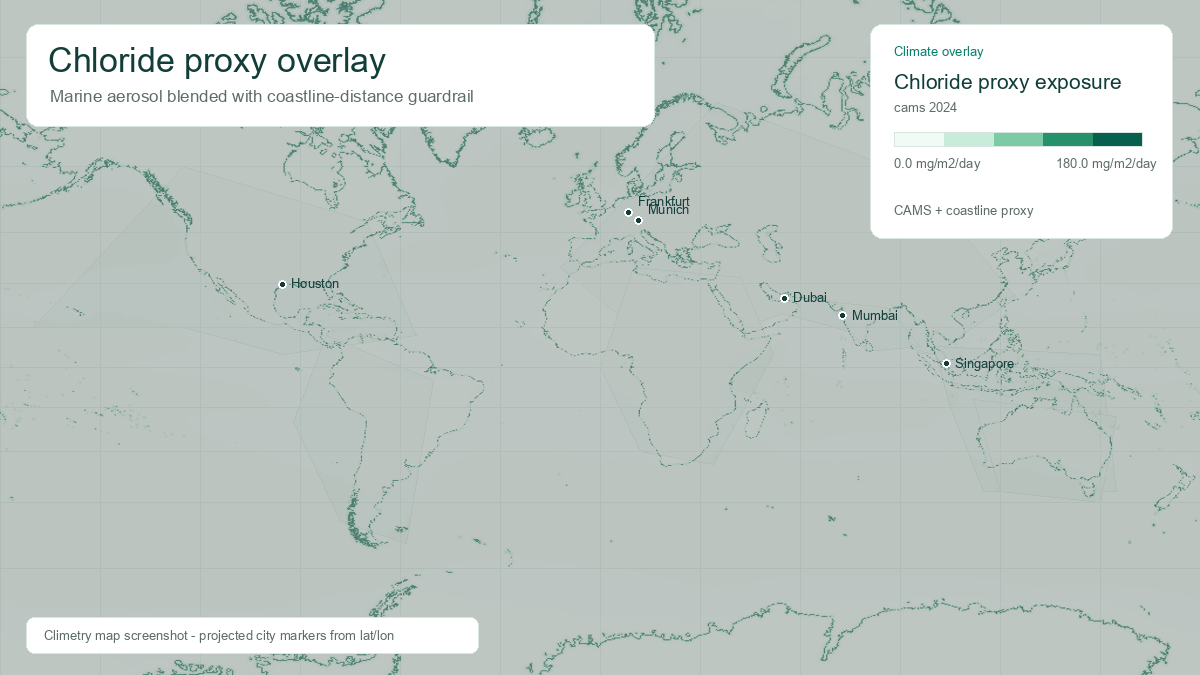
The problem becomes even more severe in tropical and subtropical climates such as Singapore, Mumbai, Houston and coastal Florida, where high humidity, elevated temperatures, marine influence and long wetness durations can combine.
Temperate benchmark with seasonal humidity and lower marine influence.
Hot marineDubaiHeat dominated, with coastal and dust modifiers for outdoor equipment.
Severe humidHoustonGulf Coast humidity, condensation relevance and industrial coastal context.
Tropical marineSingaporePersistent humidity, high dew point and coastal corrosion relevance.
Tropical marineMumbaiMonsoon humidity and marine aerosols create severe coastal exposure.
What manufacturers already do
Many manufacturers offer coated heat exchanger fins, marine coatings, corrosion-resistant housings, improved drainage systems and stainless fasteners. Examples include Blue Fin coatings, Gold Fin coatings and epoxy-coated coils.
These measures acknowledge that environmental exposure can significantly influence service life. The engineering question is which locations require standard protection and which locations justify enhanced corrosion protection.
Climate exposure is more important than temperature alone
Many people assume that hot climates are always the most severe. However, a moderate coastal climate may create greater corrosion exposure than a hot dry environment.
Temperature alone rarely tells the full story. Humidity, condensation potential, marine influence, wetness duration and pollution context determine the exposure that an outdoor unit must survive.
Environmental exposure screening
Climate-based environmental screening considers humidity exposure, condensation potential, marine influence, temperature cycles and wetness duration. These indicators help answer practical questions before equipment is selected or installed.
Climetry translates climate data into screening indicators that support this engineering decision.
Climetry translates climate data into screening indicators that support this engineering decision.
Climetry translates climate data into screening indicators that support this engineering decision.
Climetry translates climate data into screening indicators that support this engineering decision.
Environmental exposure does not predict exact corrosion rates, but it helps identify locations where additional protection may be necessary.
The future of heat pump qualification
As heat pumps become increasingly common in coastal and humid regions, environmental exposure may become a more important design consideration.
Questions such as how humid the location is, how often surfaces become wet, how strong the marine influence is, and whether the environment is comparable to tropical climates may become as important as heating performance itself.
Conclusion
Heat pump corrosion is often not caused by a single defect. Instead, it results from the interaction of humidity, condensation, salt exposure and climate conditions.
Understanding environmental exposure allows manufacturers, installers and owners to make better decisions about materials, coatings, maintenance and equipment selection.
Climate does not determine whether a heat pump will fail. But it strongly influences the environment in which it must survive.
Check the climate exposure before installation.
Analyze humidity, condensation potential, marine influence and environmental severity for coastal and humid locations.